

• Books
    • All E-Books
    • The Natural Soapmaking Book for Beginners
    • Easy Soap Making Book
  • Food
  • Soap Recipes
  • Beauty
  • Home and Garden
    • Holidays
  • Herbs and Essential Oils
  • Homestead Hop
  • Shop
  • Blog
Simple Life MomSimple Life Mom
  • Books
    • All E-Books
    • The Natural Soapmaking Book for Beginners
    • Easy Soap Making Book
  • Food
  • Soap Recipes
  • Beauty
  • Home and Garden
    • Holidays
  • Herbs and Essential Oils
  • Homestead Hop
  • Shop
  • Blog

How is Coffee Made Decaffeinated

Posted by Kelly Natural Health, Real Food Issues and Guides 21 comments
Simple Life Mom Shop - Homemade Organic Skin Care Products
Please Share

I have never been a big coffee drinker. I would always add lots of chocolate, cream, and sugar. In the past few years I’ve been drinking more and more. Basically, I replaced Pepsi with sweet tea, and replaced sweet tea with coffee (decaf mocha with skim milk and no added sugar to be exact). Here I am thinking I’ve found a treat for myself that’s mostly ok when my husband asks the question: “So, How is coffee made decaffeinated?” He goes on to say that coffee beans are naturally caffeinated so (teasing me) they must use some toxic process to make it decaf. Ugh!! So, I had to do some research!
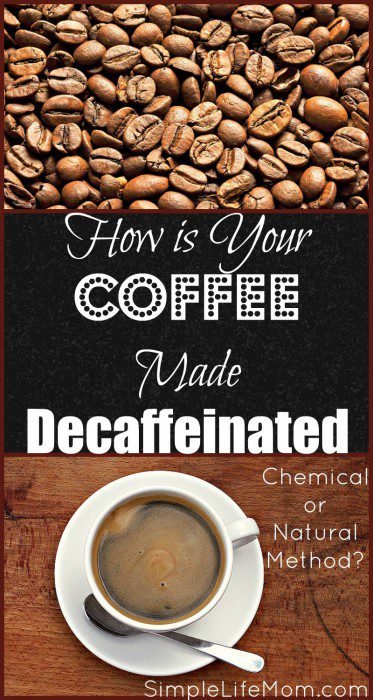
How is Coffee Made Decaffeinated? Is your coffee made decaf through natural or chemical methods

How is Coffee Made Decaffeinated?

There are a number of methods. I’m going to give you a quick summary of the ones I’ve been reading about so that you can find out how your favorite brand is made.

FYI (according to Little Coffee Place): Coffee must have 97% of its caffeine removed to be considered Decaf in America.

The Early Days

The first decaf coffee was made steamed in a brine and then rinsed with benzene!

Holy Cow! Benzene, a.k.a. Major carcinogen, found in cigarette smoke, by-product of coal burning, petroleum, forest fires, or volcanic ash. Today it is used in the manufacturing of nylon and some other plastics.

It was even in after shave in the 1920s-50s until people started getting major headaches, dizziness, vomiting, etc. from it.

Thus, companies decided it may not be good to make decaffeinated coffee using the steam/benzene method.

What Came Next

Methylene Chloride (a.k.a Water Method)

The method of steaming remained, but benzene was replaced with Methylene Chloride.

After being steamed to bring caffeine to the surface of the bean, green coffee beans are repeatedly rinsed by a water and methylene chloride solution (They are sometimes soaked instead like the method below). After about 10 hours of this, the beans are steamed for another 12 hours to make sure all of the methylene chloride is removed. Then the beans are roasted.

Safety Concerns: The CDC states that it is “Reasonably Anticipated to be a Human Carcinogen “ and is used as a paint stripper. OSHA states, “OSHA considers methylene chloride to be a potential occupational carcinogen. Short-term exposures to high concentrations may cause mental confusion, lightheadedness, nausea, vomiting, and headache. Continued exposure may also cause eye and respiratory tract irritation.“2

FDA statement: Most decaffeinated coffee has less than 0.1 parts per million (ppm) of residual methylene chloride, 100 times less than the maximum level of 10 ppm allowed by the FDA. (according to Neptune Coffee)

Yes, it is steamed for 12 hours in some facilities, but there is a small amount that remains. These small amounts from everywhere we turn these days add up. So….not much better than benzene in my opinion.

Ethyl Acetate Steaming Method (a.k.a. Natural Method):

Green coffee beans soaked in water to draw off caffeine and coffee flavor. They take this liquid and add ethyl acetate, which absorbs the caffeine. The water is steamed to remove the ethyl acetate so that the water can be used to re-flavor the beans. After this the beans and dried and ready to be used.

Safety Concerns: Ethyl Acetate is a natural byproduct of fermentation, such as the fermentation of wine. It is also made synthetically, and although the chemicals used in this process are considered low toxic, high exposure symptoms and results are similar to those above. So…we may say this is better, but still questionable if you are looking for something you can be completely happy with.

Charcoal Method (a.k.a. Swiss Water Process):

This method is the same as described above, but instead of using ethyl acetate, the caffeinated water is passed through a bed of charcoal (kind of like when you filter your water). This is considered an organic and very safe method.

Triglycerides Method (Coffee Grounds Method):

I thought this was pretty interesting. The green coffee beans are soaked to bring the caffeine to the surface and then coffee oils found in spent coffee grounds are placed on the beans to absorb the caffeine out of them. This is also considered a organic and safe method.

Super Critical Carbon Dioxide Method:

Green coffee beans are prepared by soaking, then they are heated and put under high pressure with carbon dioxide. The carbon dioxide is “pushed” into the beans and absorbs the caffeine. The carbon dioxide is then “drawn off” in some method and whatever remained in the bean evaporates as a gas. This is also considered an organic and safe method.

How is Coffee Made Decaffeinated ? Find out which method your brand uses at Simplelifemom.com

Who Uses What Method?

So here’s the BIG question. Who’s safe and who’s not? I doubt if I simply asked someone at Dunkin Donuts they would know, but I may be surprised. Through their websites and messaging, this is what I have been told about the following companies:

Bad:

Coffee Bean – Methylene Chloride Method

Starbucks – Starbucks still has the notice up on their site that they use the Super Critical Carbon Dioxide Method for their Sumatra Decaf Coffee. Unfortunately, Starbucks discontinued this coffee!! I wrote to them and received an email stating that they only use the Methylene Chloride method. Not Good!!

Better:

Dunkin’ Donuts – I received an email stating that they use the Carbon Dioxide method AND the Ethyl Acetate Method. I asked which places or coffees use which method and was told – “We don’t know.” Ummm, someone has to know…..

Folgers – Folgers is owner by Smuckers, as is Dunkin’ Donuts, Millstone Coffee Co., and Medaglia D’oro, Cafe Bustelo, and Kava. Thus, I received the same email stating they use Carbon Dioxide and Ethyl Acetate among their brands.

Best:

Allegro – Swiss Water Method

Caribou – Coffee Grounds Method

Swiss Water – Swiss Water Method (7)

That’s all the info. I have right now. If you have a favorite brand or company and find out their method, let us know and I’ll add it to our list.

Save


Please Share
21 comments

About Kelly

Kelly is the author of number one best seller The Natural Soap Making Book for Beginners and Easy Soap Making. She's also written multiple ebooks on herbal remedies and natural bath and body DIYs.Her journey toward better health has inspired her to make things in and around the home from scratch, start a homestead, and become more resourceful when it comes to health and home.She shares her recipes and DIYs here on Simple Life Mom and has a shop where she sells products for those who would rather buy than make (SimpleLifeMom.com/shop).

21 comments

Leave your reply.
  • Carol J. Alexander
    · Reply

    November 2, 2015 at 9:00 AM

    Where I live we have several local roasters. They can tell you which method and my favorite roaster sells coffee using the Swiss water method. It always pays to buy local. 🙂

    • Kelly
      · Reply

      Author
      November 2, 2015 at 9:02 AM

      That’s the truth! That’s wonderful that you have roasters.

  • KC the Kitchen Chopper
    · Reply

    November 6, 2015 at 9:31 PM

    My head hurts. 😉 I guess I’m grateful I can handle the “high octane” stuff.

    • Kelly
      · Reply

      Author
      November 7, 2015 at 9:33 PM

      Ha ha, just cut down to the bottom part that says what’s ok and not ok 😉

  • Diane
    · Reply

    November 6, 2015 at 11:19 PM

    Thanks for going through all this research for us. It’s nice to know there are a few choices out there that are failrly healthy. We drink Seattle’s Best organic bean and grind them ourselves. Not Decaf, but now i know how to find healthy Decaf! thanks!

    • Kelly
      · Reply

      Author
      November 7, 2015 at 9:33 PM

      You’re welcome Diane.

  • Sandra
    · Reply

    November 6, 2015 at 11:52 PM

    Yikes! I never really thought how coffee was decaffeinated. I love my coffee and only buy full-strength 🙂

    • Kelly
      · Reply

      Author
      November 7, 2015 at 9:32 PM

      Sandra, I think I would literally pass out with full strength coffee. It is a funny (rather hyper) sight to behold. You’re stronger than I am 🙂

  • Katerina
    · Reply

    November 7, 2015 at 1:25 AM

    I don’t drink coffee but my husband does and I always say to him to cut them down a bit. I will try this and see what happens!

  • Erlene
    · Reply

    November 7, 2015 at 4:15 AM

    I had no idea of these different methods to prepare decaf coffee. I don’t drink decaf, but it’s scary to think that some of these methods are considered acceptable. Will keep this in mind if I ever buy decaf.

    • Kelly
      · Reply

      Author
      November 7, 2015 at 9:31 PM

      I think the mindset to ask about how all our foods are processed is a great habit.

  • Marjie@homeagainjiggetyjig.com/wp
    · Reply

    November 7, 2015 at 4:32 AM

    I DO drink decaf coffee, so I’m running kinda scared right now, ’cause I’m sure mine is prepared with chemicals. So……… I drank Celestial Seasonings Ginger Bread tea tonight!

    • Kelly
      · Reply

      Author
      November 7, 2015 at 9:31 PM

      ugh, well, hopefully one of the better brands listed above is available to you. I’m hoping more pressure will come to certain brands to change. I mean, that Starbucks uses the worst is pretty pitiful!

  • Nicky
    · Reply

    November 7, 2015 at 7:59 PM

    I didn’t know that there were so many ways to decaffeinate coffee. From now on, I will turn to something other than coffee for a decaf beverage.

    • Kelly
      · Reply

      Author
      November 7, 2015 at 9:29 PM

      Yes, or find out how your favorite brand processes it. It’s not bad if it’s done in a one of the healthy ways.

  • katy allred
    · Reply

    November 7, 2015 at 10:20 PM

    How interesting, I’ve never thought about how they went about decaffienating coffee! I like mine with caffeine 🙂

  • Joy @ Joy Love Food
    · Reply

    November 8, 2015 at 7:12 PM

    This is so interesting, I’m glad that there are some healthy methods of making decaf coffee, though I like mine with caffeine.

  • Betsy @ Desserts Required
    · Reply

    November 8, 2015 at 9:46 PM

    Well, as a decaf drinking this is NOT exactly good news but it very good to know!

    • Kelly
      · Reply

      Author
      November 8, 2015 at 10:24 PM

      Yes, it’s better to know, than be drinking in ignorance 🙂

  • Jamie @ Medium Sized Family
    · Reply

    November 11, 2015 at 9:09 AM

    Super interesting. I’m a full strength girl, but good to know about this!

Leave a reply

We'd love to hear your thoughts and ideas!
Cancel reply

Recipe Rating


Join the Simple Life Mom Community

And get a FREE Bath and Body Recipe E-Book:

Thank you!

Check your email and add me to your address list so messages don't go to spam. 

You'll have a link to the free e-book in the email.

Kelly

SHOP

Join Us and Get New DIYs and Recipes Subscribe

Categories

  • Soap Making
  • Bath and Beauty
  • Health and Essential Oils
  • Home and Garden
  • Homestead Blog Hop
  • Real Food Recipes

Books

  • Natural Soap Making Book for Beginners
  • Easy Soap Making
  • Natural Soap Making How-To and Recipe Book
  • Make it Yourself: Bath & Home DIY for Self Sustainability
  • Natural Beauty from Head to Toe
  • Herbs & Essential Oils in Soap Making

SHOP

Other Resources

  • Mountain Rose Herbs
  • Herbal Academy
  • Amazon
  • Revelation Health

© 2026 Simple Life Mom - All Rights Reserved

  • Disclaimers/Policies for Simple Life Mom

Press Enter to search · Esc to close