
• Books
    • All E-Books
    • The Natural Soapmaking Book for Beginners
    • Easy Soap Making Book
  • Food
  • Soap Recipes
  • Beauty
  • Home and Garden
    • Holidays
  • Herbs and Essential Oils
  • Homestead Hop
  • Shop
  • Blog
Simple Life MomSimple Life Mom
  • Books
    • All E-Books
    • The Natural Soapmaking Book for Beginners
    • Easy Soap Making Book
  • Food
  • Soap Recipes
  • Beauty
  • Home and Garden
    • Holidays
  • Herbs and Essential Oils
  • Homestead Hop
  • Shop
  • Blog

5 Herbal Shampoo Bar Recipes

Posted by Kelly Hair, Handmade Soap, Homemade Soap Recipes 55 comments
Please Share

My 7 Homemade Shampoo Recipes has been a huge hit over the years.  It’s definitely time to give you more recipes …again, all in one place. These shampoo bar recipes are 100% natural, pure, healthy, and palm free. I’ve added a few vegan options for you as well.
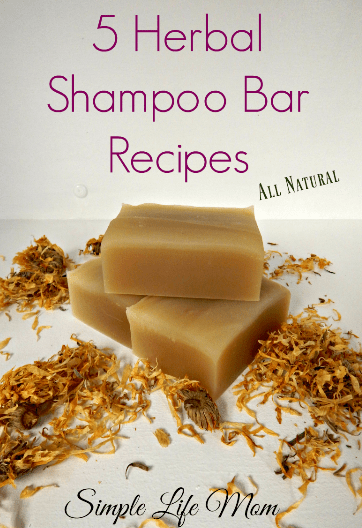
5 Herbal Shampoo Bar Recipes from Simple Life Mom

These Herbal shampoo bar recipes are made with pure ingredients using the cold process method. I’ve included instructions with each recipe, but if you need more in depth instructions you can check out 7 Easy Steps to Handmade Lye Soap for Beginners or one of my books.

A hard copy book with very comprehensive instructions (the only book you’ll ever need for cold process soap making) can be found on Amazon: The Natural Soapmaking Book for Beginners. Or you can get my Ebook: Natural Soap Making How-to and Recipe Book

How to Use an Herbal Shampoo Bar

If you’ve never used a shampoo bar before, relax. It’s easy. Simply lather the shampoo bar in your hands or with a wash cloth or scrunchy and work into your hair. Rinse, and follow up with a lightly acidic conditioner. I like to use apple cider vinegar that is diluted in half with water in a spray bottle. Simple spray and rinse.

Sometimes natural shampoo bars can still be slightly basic after curing (nothing drastic, just slightly). The diluted apple cider vinegar makes sure you have a neutral pH and helps the hair shaft close and maintain healthiness. This will also reduce frizz and the amount of minerals that bond with the hair.

That’s right, sometimes those with harder water have a more difficult making the transition to handmade shampoo bars. This is because their water is filled with minerals that will bond with the hair when using a natural soap product. You’ll know if you have hard water because you’ll probably also have a harder time keeping your shower walls clean. Mineral deposits will form on walls over time. Use the apple cider vinegar rinse and this should help the transition. If this isn’t enough, try a commercial conditioner with good ingredients to ease your transition. If worse comes to worse, a filter shower head is amazing for hair!

5 Herbal Shampoo Bar Recipes

Each of these herbal shampoo recipes have been created for all hair types. Every type of hair can benefit from the vitamins and nourishing qualities of the milks, oils, and herbs within these shampoos.

Lavender is very soothing to the scalp, as is chamomile. Coconut milk, aloe, and goats milk are nourishing and balancing. Calendula is healing, while rosemary stimulates natural balance and hair growth. So, try each recipe and find your favorite.
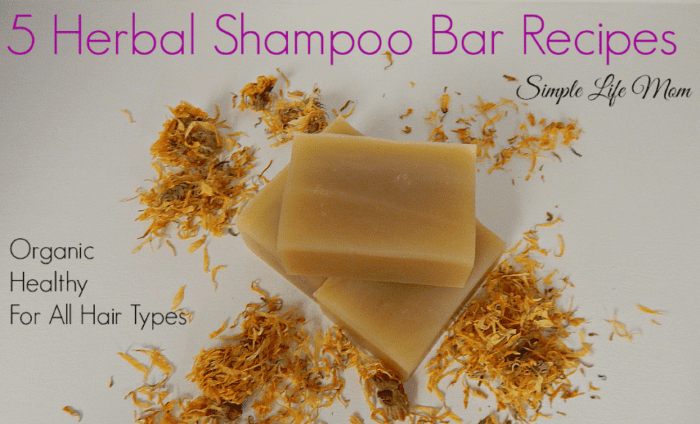
5 Herbal Shampoo Bar Recipes from Simple Life Mom

Coconut Milk and Lavender Shampoo

3lb (12 – 4oz bars) – 7% superfat

Ingredients:

  • 10 ounces Olive Oil
  • 10 ounces Coconut Oil
  • 5 ounces Cocoa Butter
  • 5 ounces Castor Oil
  • 3 ounces Avocado Oil
  • 2 ounces Shea Butter
  • 13 ounces Coconut Milk
  • 4.8 ounces Lye
  • 1 ounce Lavender Essential Oil

Directions:

  1. Combine oils and butters in a large pot. Melt and cool to 110 degrees Fahrenheit.
  2. Wearing appropriate safety equipment, go outside and add lye to water and stir until dissolved. Let cool until it is around 110 degrees Fahrenheit.
  3. When both oils and lye-coconut milk are at desired temperatures, pour lye/coconut milk into oils and use a stick blender to blend on and off until light trace.
  4. Add essential oil and blend.
  5. Pour into a lined mold and insulate for 24 hours.
  6. Remove, cut, and cure for 4-6 weeks.
Chamomile Lemon Shampoo

2lb (Eight – 4oz bars) – 7% superfat

Ingredients:

  • 7 ounces Lard or Tallow
  • 6 ounces Coconut Oil
  • 5 ounces Castor Oil
  • 3 ounces Hazelnut Oil
  • 3 ounces Olive Oil
  • 1-2 Tablespoons dried Chamomile flowers
  • 9 ounces Filtered Water
  • 3.3 ounces Lye
  • 1 ounce Lemon Essential Oil

Directions:

  1. Combine lard and oils in a large pot. Add chamomile flowers. Melt and cool to 110 degrees Fahrenheit.
  2. Wearing appropriate safety equipment, go outside and add lye to water and stir until dissolved. Let cool until it is around 110 degrees Fahrenheit.
  3. When both oils and lye water are at desired temperatures, pour lye water into oils and use a stick blender to blend on and off until light trace.
  4. Add essential oil and blend.
  5. Pour into a lined mold and insulate for 24 hours.
  6. Remove, cut, and cure for 4-6 weeks.

Orange and Aloe Shampoo

2lb (Eight – 4oz bars) – 5% superfat

Ingredients:

  • 6 ounces Coconut Oil
  • 5 ounces Mango Seed Butter
  • 5 ounces Castor Oil
  • 3 ounces Olive Oil
  • 3 ounces Apricot Kernel Oil
  • 8 ounces Aloe Liquid (not gel)
  • 3 ounces Lye
  • 1 ounce Orange Essential Oil

Directions:

  1. Combine oils and butter in a large pot.  Melt and cool to 110 degrees Fahrenheit.
  2. Wearing appropriate safety equipment, go outside and add lye to aloe water and stir until dissolved. Let cool until it is around 110 degrees Fahrenheit.
  3. When both oils and lye aloe water are at desired temperatures, pour lye water into oils and use a stick blender to blend on and off until light trace.
  4. Add essential oil and blend.
  5. Pour into a lined mold and insulate for 24 hours.
  6. Remove, cut, and cure for 4-6 weeks.

Goat Milk and Elder Flower Shampoo

2lb (Eight – 4oz bars) – 5% superfat

Ingredients:

  • 6 ounces Coconut Oil
  • 5 ounces Castor Oil
  • 4 ounces Cocoa Butter
  • 3 ounces Jojoba Oil
  • 3 ounces Sweet Almond Oil
  • 2 ounces Shea Butter
  • 5 ounces Goat Milk
  • 3 ounces Filtered Water
  • 3 ounces Lye
  • 1 ounce Ylang Ylang Essential Oil
  • 1/4 cup Elder Flowers

Directions:

  1. Weigh and add sweet almond oil and elder flowers to a small sauce pan and heat on low for 15 minutes. Strain.
  2. Weigh goat milk and water and freeze until slushy.
  3. Combine oils (including the infused sweet almond oil) and butters in a large pot. Melt and cool to 110 degrees Fahrenheit.
  4. Wearing appropriate safety equipment, go outside and add lye to cold goat milk and water and stir until dissolved. Let cool until it is around 110 degrees Fahrenheit.
  5. When both oils and lye water are at desired temperatures, pour lye water into oils and use a stick blender to blend on and off until light trace.
  6. Add essential oil and blend.
  7. Pour into a lined mold and insulate for 24 hours.
  8. Remove, cut, and cure for 4-6 weeks.

Calendula and Rosemary Shampoo

3lb (12 – 4oz bars) – 10% superfat

Ingredients:

  • 7 ounces Coconut Oil
  • 5 ounces Olive Oil
  • 5 ounces Castor Oil
  • 5 ounces Cocoa Butter
  • 3 ounces Jojoba Oil
  • 2 ounces Shea Butter
  • 1 ounce Rosehip Oil
  • 10 ounces Filtered Water
  • 3.5 ounces Lye
  • 1 ounce Rosemary Essential Oil
  • 1/4 cup Calendula Flowers

Directions:

  1. Add olive oil and calendula flowers to a small sauce pan and heat on low for 15 minutes. Strain.
  2. Combine oils (including the infused olive oil) and butters in a large pot. Melt and cool to 110 degrees Fahrenheit.
  3. Wearing appropriate safety equipment, go outside and add lye to water and stir until dissolved. Let cool until it is around 110 degrees Fahrenheit.
  4. When both oils and lye water are at desired temperatures, pour lye water into oils and use a stick blender to blend on and off until light trace.
  5. Add essential oil and blend.
  6. Pour into a lined mold and insulate for 24 hours.
  7. Remove, cut, and cure for 4-6 weeks.

Please Share
55 comments

About Kelly

Kelly is the author of number one best seller The Natural Soap Making Book for Beginners and Easy Soap Making. She's also written multiple ebooks on herbal remedies and natural bath and body DIYs. Her journey toward better health has inspired her to make things in and around the home from scratch, start a homestead, and become more resourceful when it comes to health and home. She shares her recipes and DIYs here on Simple Life Mom and has a shop where she sells products for those who would rather buy than make (SimpleLifeMom.com/shop).

You also might be interested in

9 Natural Hair DIYs: shampoo, condition, harispray, gel, dye and highlight, detanlger, dry shampoo and dandruff relief by Simple Life Mom

9 Natural Hair DIYs: Dye, Hold, Clean, Condition

May 3, 2020

Please Share There are so many products that we use[...]

4 Hair Type Shampoo Bar Recipes from Simple Life Mom

4 Shampoo Bar Recipes for All Hair Types

Aug 4, 2019

Please Share I get a lot of questions asking which[...]

3 Fall Shampoo Bar Recipes from Simple Life Mom

Make 3 Easy Fall Shampoo Bar Recipes

Sep 1, 2025

Please Share Are you ready to create some amazing Fall[...]

55 comments

Leave your reply.
  • Ellen
    · Reply

    July 23, 2018 at 3:57 PM

    Will these shampoo bars strip the dye from colored hair so that it fades faster? I’ve never tried a shampoo bar and have been hesitant to try natural shampoos because of it. I only shampoo twice a week.

    Also, do shampoo bars have less fats than regular soap? I’m curious if it would dry out skin if you let it drip down and use it as body soap.

    • Barb
      · Reply

      August 16, 2018 at 5:53 AM

      Ellen I make my own shampoo bars too. I’ve found it actually helps the color last longer. If you only wash your hair twice a week make sure you spend the time to get the suds all over your scalp, especially if your hair is long. Apple cider vinegar is a great rinse. It works amazing. I use it full strength and just pour on.

      • Ellen
        · Reply

        August 27, 2018 at 9:14 PM

        Thanks Barb! I have black dyed shoulder length hair and was wary about using shampoo bars, baking soda, & apple cider vinegar on it even though I’ve read about going no ‘poo.

  • Christine Elwood
    · Reply

    September 25, 2018 at 2:10 PM

    I recently read your book Beginning Soap Making. I was very concerned when I read your recipes that are labeled Nut-free and they had Shea butter in them. I am not a novice soap maker but I am always looking for new soap recipes that are nut free as I have a granddaughter with severe allergies to any nuts. I had read Shea butter should not be used by anyone with nut allergies so I asked her Allergy Dr. and he said no one with nut allergies should use Shea butter/oil. So please don’t list Shea butter as a nut free ingredient, it can cause a anaphylactic reaction that could be deadly for someone with nut allergies. Thank you Christine E.

    • Kelly
      · Reply

      Author
      September 25, 2018 at 2:32 PM

      Thank you for mentioning your concerns Christine. Interestingly, we have a lot of tree and ground nut allergies on my side of the family and I even double checked with my allergist and my sister checked with theirs and both said shea butter would not be an allergy for those with nut allergies. Something about the enzymes being different. That’s something that should definitely be looked into, because of course that would be horrible for someone to not catch and have a reaction to.

  • Saltean
    · Reply

    October 3, 2018 at 4:06 AM

    Shampoo bars sound so interesting. Thanks for sharing the recipes .

  • rez
    · Reply

    October 3, 2018 at 3:27 PM

    how much water needed for the coconut milk and lavender shampoo? Do I need to freeze milk ?

    • Kelly
      · Reply

      Author
      October 8, 2018 at 8:50 AM

      Follow the recipe. If you’re using all coconut milk it takes the place of water in the recipe. You don’t need to freeze, but you can cool it before adding lye.

      • Kelly Vasconcelos
        · Reply

        June 18, 2019 at 9:48 AM

        I added the coconut to the water and the whole thing turned into a very yellow color and a strong smell. I did not know if it was normal so I started again putting the SH into the coconut milk and it did not work again ( it started to get really thick just like soap). Do you know what is the problem?

        • Kelly
          · Reply

          Author
          June 18, 2019 at 10:19 AM

          No problem. What happens with some herbal waters or milks is that the lye heats them so rapidly that it actually scalds the milk or herbs. This burning cannot be fully avoided, but can be helped by freezing the herb water or milk before adding the lye. The lye will melt the ice but at a slower rate, minimizing the scald. If you use super cold water and there is still a slight or medium amount of scalding it really is no problem. Your soap will still turn out great. It will just be a little darker.

        • Dulce Coutino
          · Reply

          September 14, 2025 at 3:47 PM

          Are this shampoos safe for kids?

          • Kelly

            Author
            September 16, 2025 at 8:41 PM

            Yes they are

  • ilinca
    · Reply

    January 4, 2019 at 1:33 AM

    Hello!can you please specify if the SF is with +or -?
    i’ve heard that shampoo recepies shouldn’t be made with sf as you don’t want any oils left in your hair,especially when you have greasy hair. Thank you!

    • Kelly
      · Reply

      Author
      January 5, 2019 at 9:12 PM

      The superfat percentage is by the title of each recipe.
      It’s ok to have a low superfat of a percentage 10% or lower. Higher may effect hair, depending on hair type. Most people have issues with not conditioning and high mineral content in water more than the sf of the shampoo bars.

  • Debie
    · Reply

    February 10, 2019 at 1:14 AM

    For the the Orange and Aloe Shampoo, could fresh aloe be used for the Aloe liquid? I have many aloe plants.

    • Kelly
      · Reply

      Author
      February 12, 2019 at 7:59 AM

      Yes, it will have more plant matter and won’t keep quite as long, but the benefits of fresh will make the shampoo bars that much more wonderful.

  • Magda
    · Reply

    February 12, 2019 at 1:32 PM

    I have a doubt about the ph of these shampoo bars made with lye. I read the natural hair and sculp ph is around 5.5. Shampoo with higher ph can dry out te hair. Do you know wich is the ph of these recipes?

    • Kelly
      · Reply

      Author
      February 16, 2019 at 8:50 PM

      Cold process bars tend to be about 5.5. They are only slightly basic. Though there is lye present in the beginning (which is extremely basic on the ph scale) the saponification process and the oils used bring the ph to almost balanced. A lightly acidic conditioner like a 50/50 water and acv spray is a perfect fix.

  • Nicole
    · Reply

    March 2, 2019 at 5:46 PM

    I made soap with an elder neighbor when I was very young, but haven’t made any in years. For the Coconut and Lavender bars; 1. You said to a previous comment to use the coconut milk to mix with the lye instead of water. 2. what do you mean by trace when mixing? 3. Do you have a recommended “lined/insulated mold”? 4. If I wanted to substitute jojoba oil, what would you recommend replacing if anything? Only things I don’t have on hand are avocado oil and castor oil..

    • Kelly
      · Reply

      Author
      March 4, 2019 at 8:54 AM

      You can replace a percentage or all of your water with a type of milk.
      Trace is when the soap starts to thicken. It’ll leave a “trace” when drizzled over the top.
      You can use any container you want to as a mold (though I don’t recommend glass because it’s hard to remove), just line it with parchment or wax paper so you can easily remove the soap.
      If you want to substitute an oil in a soap I recommend running it through a lye calculator to make sure it’s a one to one ratio change. You may be able to get away with changing the avocado oil for jojoba.

  • Marie L Edwards
    · Reply

    June 1, 2019 at 9:46 AM

    I just found your website, Kelly, and thank you so much for the wealth of knowledge, recipes and advice. I am curious about your treatment of milks in your CP recipes. All recipes I’ve seen so far instruct you to freeze milks, then add slowly to lye to prevent burning. Do you not encounter the burning problem that turns lye water brown and smelly?

    • Kelly
      · Reply

      Author
      June 1, 2019 at 7:42 PM

      I use very cold water and it does turn a little orange, but the soap is still a light creamy color in the end.

  • Cindy
    · Reply

    July 10, 2019 at 6:32 PM

    Hi,

    I made one of your shampoo bar recipes a couple months ago and love it. I was wondering if you could answer a question for me if you can. I want to turn the shampoo bar into a liquid – I tried the other day, I cut off about 1/4 of the bar and cut into small cubes, boiled water and poured over and let it melt. I then put into a bottle with a flip top. My question is – since this is using/adding water (altho boiled), is it okay to use it like this because it has no preservative? I did use the portion I made in about 2 weeks. I would only do 1/4 of the bar at a time.
    Thanks, Cindy

    • Kelly
      · Reply

      Author
      July 15, 2019 at 11:56 AM

      Yes, you did great! It should definitely last as long as it takes for you to use it without any preservatives.

  • Colleen Mewha
    · Reply

    August 18, 2019 at 9:19 PM

    I have a coconut allergy. As much as I want to try making my own shampoo bars, I need a recipe without coconut. do you have one?

    • Kelly
      · Reply

      Author
      August 21, 2019 at 7:54 AM

      Hi Colleen,
      Number one and number four of these recipes have no coconut oil. https://simplelifemom.com/2013/11/19/7-homemade-shampoo-bar-recipes/

  • LeAne
    · Reply

    September 21, 2019 at 10:03 PM

    I cannot wait to try some of these recipes. Shampoo bars have struck an interest in me lately. Can you tell me what is the best way to insulate my mold for the first 24 hours? thank you.

    • Kelly
      · Reply

      Author
      September 23, 2019 at 8:02 AM

      If your home is above 70 then a light cover (mold cover, plastic wrap, small towel) on your mold is usually all that’s needed to ensure a full gel. During winter months in a cool house wrap in a blanket.
      This will also depend on whether you used any sugars (fruits, milk, honey) or “hot” essential oils like clove, or some fragrance oils. These things can cause
      Soap to heat so you make to make sure you don’t wrap them too heavy so that they over heat.

  • Magda Minnaar
    · Reply

    November 28, 2019 at 4:34 AM

    I would like to know what it is in kilograms. Thank you

    • Kelly
      · Reply

      Author
      December 3, 2019 at 6:08 PM

      Just do an internet search for conversions.

  • Wendy
    · Reply

    February 4, 2020 at 5:05 PM

    Can coconut milk subbed 1:1 for goat milk in the Goat Milk and Elder Flower Shampoo (I realize it would then be Coconut Milk and Elder Flower Shampoo 🙂 )

    • Kelly
      · Reply

      Author
      February 7, 2020 at 7:15 AM

      Yes, sounds fabulous!

  • Colleen
    · Reply

    July 15, 2020 at 1:31 PM

    Hi Kelly,
    What type of chamomile are you using in the Chamomile and Lemon shampoo bar?

    Is it powder or whole flower or tea leaves

    • Kelly
      · Reply

      Author
      July 19, 2020 at 5:10 PM

      Sorry, you can add either one that you have on hand. Tea tends to have just the flowers as well.

  • Fhumulani
    · Reply

    July 23, 2020 at 8:55 AM

    Can I use apple cider bar to rinse out the shampoo bar, just thinking if I was travelling and had to shampoo my hair, carrying the apple cider vinegar bottle is not ideal but a bar can be.

    • Kelly
      · Reply

      Author
      July 27, 2020 at 9:39 AM

      This is for apple cider, not apple cider vinegar. An apple cider vinegar shampoo bar is still a shampoo bar, but it can possibly have a little lower pH.

  • Lisa Win
    · Reply

    October 28, 2020 at 9:55 PM

    Thanks for this amazing reciepies. How do you make shampoo bars without lye?

    • Kelly
      · Reply

      Author
      November 3, 2020 at 6:40 PM

      You cannot make soap or shampoo without lye. Lye is needed to turn the oils into soap.

  • Taylor Brush
    · Reply

    November 9, 2020 at 10:44 AM

    Hi, I followed the lavender coconut milk recipe and the soaps came out very soft and moist. Just wondering if this is normal, what I can do to fix it, and what can I change in the future.

    Thank you!

    • Kelly
      · Reply

      Author
      November 15, 2020 at 4:17 PM

      They should dry out and harden within a few days. Next time try pouring the lye into oil when it’s at a cooler temperature (90 degrees). You can also add a tiny bit less water.

  • Jan Andersen
    · Reply

    June 15, 2021 at 7:00 AM

    Hi can you help me, what is Ounces? when I try to translate into danish nothing comes up

    • Kelly
      · Reply

      Author
      June 15, 2021 at 7:53 AM

      It is a weight. 16 ounces make a pound. 1 ounce is about 30 grams if that helps.

  • Jan Andersen
    · Reply

    June 15, 2021 at 7:05 AM

    Hi again the Lye and the water, do you heart it up when you mixe them outside? can you replace the water with Rice water?, Coconut water/milk? or pure aloe vera juice?

    • Kelly
      · Reply

      Author
      June 15, 2021 at 7:51 AM

      You do not heat the lye water. It creates a chemical reaction when added to liquid and will heat up all on its own.
      You can replace the water with a milk or other liquid. I would start with a smaller amount in place of the water if you’re just starting out with soap making. ye can burn milk solids and proteins or plant matter within liquids, so replacing only 50% of the water and making sure it is very cold is a good practice until you’re used to changing recipes in this way.

  • Jess
    · Reply

    April 10, 2022 at 9:44 AM

    Hi Kelly,
    I have started making soap for my family based off your recipes. I greatly appreciate your book and website and all the knowledge you share. I was even able to get my preteen son to shower more often because he loves trying out all the new soaps! Score! Haha. But, I haven’t been able to figure out what differentiates a body bar from a shampoo bar? I have just been following your titles and using each accordingly, but can any soap bar be used as shampoo?

    • Kelly
      · Reply

      Author
      April 13, 2022 at 8:49 PM

      they can be used interchangeably, depending on your hair type. Shampoo bars generally use different oils that add to hair needs, whereas the rest of the body isn’t as picky.

  • Sharon
    · Reply

    June 28, 2024 at 10:10 AM

    Hi Kelly!!!
    You really have me laughing this morning! I was doing a search for what the most natural preservative would be to be added to a conditioner bar above 140 degrees f.

    Well, actually I was honestly at that point just trying to figure out the difference between all the optiphen preservatives. Since I would be able to use one of these if necessary and would prefer to get one that’s multiple purpose.

    However, I was brought to you. And full disclosure, I am a herbalist as well, so while reading I of course am thinking this is a girl after my own heart!!! I click on the link to your book, an tada!!! I of course already own it!!! Any chance you might be able to assist me with a natural preservative with the temperature requirements I’m looking for? I would greatly appreciate it!!! Thank you so very, very much!!! Also, if you ever have any questions about plants. Please let me know, I love nothing more than discussing their benefits. I’m also recently disabled, so I miss adult conversations on the topics I enjoy! lol. Thank you!!! ☺️

    • Kelly
      · Reply

      Author
      June 28, 2024 at 10:59 AM

      Hi Sharon, nice to meet you! I use vitamin e and rosemary essential oil that slows oil oxidation. I’ll also use alcohol or vinegar if making an extract or fermentation. I don’t use anything else. I’ve never needed to.

  • Sonia
    · Reply

    October 10, 2024 at 1:04 PM

    Can goat’s milk be replaced by vegetable milk such as cooconut milk? thanks

    • Kelly
      · Reply

      Author
      October 11, 2024 at 6:20 PM

      Yes it definitely can.

  • Roxane
    · Reply

    January 6, 2025 at 11:23 AM

    Hello, I was wondering if I use a 1:1 lye solution would that work? And add the milks or extra water to the oils? I really want to try to make the shampoo bars and wonder if switching to the 1:1lye solution would make a difference.

    Thank you

    • Kelly
      · Reply

      Author
      January 6, 2025 at 11:31 AM

      What exactly do you mean by 1:1 lye solution?

Leave a Reply

We'd love to hear your thoughts and ideas!
Cancel Reply

Recipe Rating


Join the Simple Life Mom Community

And get a FREE Bath and Body Recipe E-Book:

Thank you!

Check your email and add me to your address list so messages don't go to spam. 

You'll have a link to the free e-book in the email.

Kelly

SHOP

Join Us and Get New DIYs and Recipes Subscribe

Categories

  • Soap Making
  • Bath and Beauty
  • Health and Essential Oils
  • Home and Garden
  • Homestead Blog Hop
  • Real Food Recipes

Books

  • Natural Soap Making Book for Beginners
  • Easy Soap Making
  • Natural Soap Making How-To and Recipe Book
  • Make it Yourself: Bath & Home DIY for Self Sustainability
  • Natural Beauty from Head to Toe
  • Herbs & Essential Oils in Soap Making

SHOP

Other Resources

  • Mountain Rose Herbs
  • Herbal Academy
  • Amazon
  • Revelation Health

© 2026 Simple Life Mom - All Rights Reserved

  • Disclaimers/Policies for Simple Life Mom

Press Enter to search · Esc to close