
• Books
    • All E-Books
    • The Natural Soapmaking Book for Beginners
    • Easy Soap Making Book
  • Food
  • Soap Recipes
  • Beauty
  • Home and Garden
    • Holidays
  • Herbs and Essential Oils
  • Homestead Hop
  • Shop
  • Blog
Simple Life MomSimple Life Mom
  • Books
    • All E-Books
    • The Natural Soapmaking Book for Beginners
    • Easy Soap Making Book
  • Food
  • Soap Recipes
  • Beauty
  • Home and Garden
    • Holidays
  • Herbs and Essential Oils
  • Homestead Hop
  • Shop
  • Blog

A Green Tea Face Soap that Finally Reduced Puffiness

Posted by Kelly Handmade Soap, Homemade Soap Recipes 20 comments
Please Share

I’m really excited to be able to share another great face soap recipe. This green tea face bar is made with vegan ingredients that nourish, reduce inflammation, cleanse, detox, and speed healing from acne.
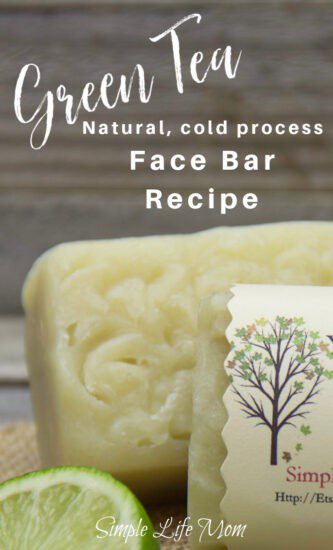
Green Tea Face Bar Recipe - cold process soap recipe from Simple Life Mom

A natural face soap recipe is so important today when so many cleansing bars or liquids are full of questionable or outright horrific ingredients. I went to the store recently and looked through shampoos and cleansers and saw that the word “clean” is definitely the popular advertising gimmick. “Clean” or “Natural” were on at least 60% of the bottles! Yet, not one of those bottles were pure and healthy.

Making your own soap and shampoos and other cosmetic and body products puts YOU in charge. Learn more about making your own bath and beauty products by clicking here.

If you’ve never made your own soap, then learn how by starting here: Lye Soap Step by Step. Or you can buy my book, Natural Soap Making Book for Beginners.

Why Use Green Tea?

Green tea has a lot of well established benefits that have been studied when taken internally. But what about for the skin?

Green tea is not fermented, so it retains a great amount of nutrients. 30% of its dry weight is antioxidants like polyphenols and catechins (1), as well as linoleic acid, quercetin, aginenin, trace minerals, and chlorophyll. It also contains a small amount of caffeine.

One of the chief benefits of green tea for the skin is the reduction of inflammation. This, along with the many trace minerals and flavonoids, creates an anti-aging effect.

Green tea is also cleansing. The anti-inflammation benefits help to reduce redness from acne, cleanse, and speed healing.

As you can see, green tea is a great addition to a face soap bar.

Adding other great ingredients to nourish the skin, add moisture, and condition, makes this an all around great bar!

Ingredients Used and Why

I’ve chosen some great oils, essential oils, and a clay for this recipe.

I’ve chosen frankincense and clary sage essential oils for scent. Feel free to switch the essential oils to something you prefer. I love the woodsy scent of clary sage and frankincense and they both have great benefits for the skin, but so do many other essential oils. Frankincense is a wonderful anti-inflammatory. Clary sage is also an anti-inflammatory. It is also an anti-bacterial, soothes the skin, and is an uplifting scent.

Avocado oil, apricot kernel oil, cocoa butter, and coconut oil are rich in antioxidants like vitamins A, E, and C, and are moisturizing and nourishing to the skin. Castor oil adds great bubbles.

French green clay is a great cleanser by drawing impurities from pores and detoxifying. It also soothes and speeds healing, making it a great choice for face soap.
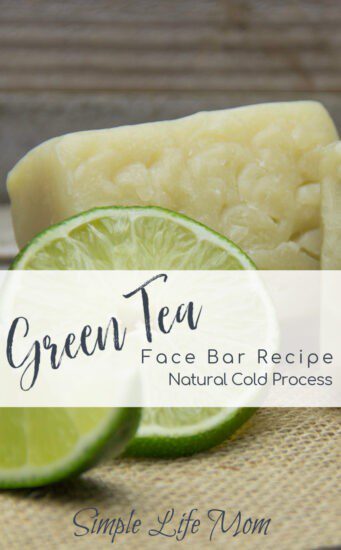
Green Tea Face Bar Recipe - cold process soap recipe from Simple Life Mom

Green Tea Face Soap Recipe

This recipe makes 2 pounds of soap, or eight 4-ounce bars.

Superfat – 10%

Ingredients:

  • 5 ounces cocoa butter
  • 5 ounces coconut oil
  • 4 ounces avocado oil
  • 4 ounces apricot kernel oil
  • 4 ounces castor oil
  • 7.7 ounces water
  • 2 Tablespoons green tea or contents of 2 green tea bags
  • 2.9 ounces lye
  • 0.35 ounces clary sage essential oil
  • 0.35 ounce frankincense essential oil
  • 2 Tablespoons French green clay

Directions:

  1. Prepare mold by lining if necessary.
  2. Combine Coconut oil, cocoa butter, avocado oil, apricot kernel oil, and castor oil in a stainless steel pot and melt over medium-low heat. Allow to cool to about 90F.
  3. Weigh lye in a plastic zip-top bag. Set aside.
  4. Bring water to boil and weigh into a plastic container. Add tea and brew for 5 minutes. Allow to cool to room temperature and then place in the freezer to cool. You don’t need to freeze solid. Just make very cold.
  5. While outside and wearing safety goggles, charcoal mask, and gloves, pour lye into tea water. Allow to cool to about 90F.
  6. When both lye water and oils are between 80-90 degrees F, pour lye water into oils and blend on and off until light trace.
  7. Add essential oils and clay and blend.
  8. Pour into prepared mold, cover, and allow to sit for 24 hours. Remove from mold and cut and cure for 3-6 weeks until hard.

Feel free to switch the essential oils to something you prefer. I love the woodsy scent of clary sage and frankincense and they both have great benefits for the skin, but so do many other essential oils.

If you don’t have French green clay, add spirulina, nettle powder, or omit.

If you have any questions, let me know. I hope you enjoy the recipe.


Please Share
20 comments

About Kelly

Kelly is the author of number one best seller The Natural Soap Making Book for Beginners and Easy Soap Making. She's also written multiple ebooks on herbal remedies and natural bath and body DIYs. Her journey toward better health has inspired her to make things in and around the home from scratch, start a homestead, and become more resourceful when it comes to health and home. She shares her recipes and DIYs here on Simple Life Mom and has a shop where she sells products for those who would rather buy than make (SimpleLifeMom.com/shop).

You also might be interested in

3 Easy Summer Herbal Shampo Recipes - hot processed with nettle, hibiscus, holy basil and essential oils from Simple Life Mom

3 Easy Summer Herbal Shampoo Recipes

Jul 21, 2024

Please Share I’ve put together 3 hot process herbal shampoo[...]

Homestead Blog Hop - Homestead tips, ideas, animal care, and recipes every Wednesday

Homestead Blog Hop 494 – Lavender Bath Salts, Growing Potatoes

Apr 23, 2024

Please Share Welcome to the Homestead Blog Hop! I’m glad[...]

7 Homemade Holiday Soap Recipes - with cloves, cinnamon, fir, or peppermint

7 Beautiful Holiday Soap Recipes

Nov 28, 2022

Please Share Each year, I make a number of holiday[...]

20 comments

Leave your reply.
  • Trish Stewart
    · Reply

    February 22, 2021 at 10:18 AM

    I have matcha green tea. Is there some way I can incorporate it into this recipe? I can’t wait to try it! It looks wonderful. Thank you

    • Kelly
      · Reply

      Author
      February 22, 2021 at 1:20 PM

      Yes, you can use match green tea in place of the green tea in the recipe. Just make a tea with the water in the recipe.

  • Yoshy Mutiart
    · Reply

    February 22, 2021 at 11:22 PM

    I wonder if I can make this recipe with hot process? Thank you

    • Kelly
      · Reply

      Author
      February 25, 2021 at 3:23 PM

      Yes, you can always make cold process soaps in hot process.

  • Rebecca
    · Reply

    February 23, 2021 at 8:37 AM

    Good morning Kelly,
    Thank you for the new soap recipe! I am very excited to try it.
    I have your soap book and I love it! I had tried many different recipes and then bought your book. Night and day difference in my soap quality. Your book is my soaping bible, and every recipe is a hit!
    I am ready to try the new Green Tea face bar soap.
    your book brought back the joy of soap making!
    Thank you
    Becky

    • Kelly
      · Reply

      Author
      February 25, 2021 at 3:23 PM

      I’m so glad you’ve been enjoying the experience!

    • Shella
      · Reply

      April 27, 2021 at 2:20 PM

      H! My name is shella I would like to no what’s other thing I can use on my soap to replace coconut oil on my soap ,please cause I’m allergic with it

      • Kelly
        · Reply

        Author
        May 9, 2021 at 1:07 PM

        You can use liquid palm oil or babassu oil.

  • Ginger Napier
    · Reply

    February 27, 2021 at 8:53 PM

    I have made your rose facial soap twice in the last few months and I LOVE it. It’s so silky on my skin I dont want to use anything else. I’ve also given it to several friends and they feel the same way.
    I’m curious about the high amount of castor oil in the green tea soap. The rose soap has a high percentage of castor oil, though not as high as the green tea. I’ve read that much castor oil will make a sticky soft bar and shouldn’t be used above 7 or 8 %. I have used as much as 10% with no problem but this bar is much higher than that. What is this bar like after it cures?
    This isnt a criticism at all, just a curiosity. I have found that there is a lot of conflicting information on the “right,”way to soap and it seems that much if it is misinformation passed on through the ages. I love castor oil in soap but have been afraid to use it at a high rate.

    • Kelly
      · Reply

      Author
      March 1, 2021 at 7:50 PM

      Questions are always great! I’ve used this amount (I believe it’s 18% of the oils) without any issues. I’ve never tried higher so I’m not sure how much higher you could go, but this makes a great bar.

  • Hafsa AlAli
    · Reply

    March 2, 2021 at 4:20 AM

    Dear Kelly,
    Thank you very much for the recipe.
    Shall we leave the tea leaves in the water when adding lye to water?

    • Kelly
      · Reply

      Author
      March 3, 2021 at 10:44 PM

      No, make a strong tea and then remove the leaves. You can leave the leaves in if you want to though.

  • KELLY-ANN GREENIDGE
    · Reply

    May 31, 2021 at 10:59 AM

    Thanks for the recipe, just one question. Does the properties of the green tea actually survive when the lye is added and saponification?

    • Kelly
      · Reply

      Author
      June 1, 2021 at 8:10 AM

      Great question. I believe that they do for many reasons. First, heat does not destroy the tea. We use hotter water than what it would encounter under saponification. Second, lye reacts with oils. The chemical process involves breaking down fatty chains and forming glycerin and new salt chains. We also know that minerals and vitamins survive from tests others have done. That all combined, it doesn’t seem like the tea properties would be harmed. If volatile essential oils can survive (we know because there’s still scent) then tea can definitely survive.

  • Carol L
    · Reply

    September 13, 2021 at 12:05 PM

    I’m new to soapmaking.. I understand that a good scale is important , that all ingredients must be weighed for accuracy. I wonder, just HOW do you weigh essential oils?
    Thank you for responding.

  • Roxanne Kimbell
    · Reply

    September 19, 2021 at 6:20 PM

    Can you use Bentonite clay instead of French green clay?

    • Kelly
      · Reply

      Author
      September 20, 2021 at 9:01 AM

      Yes, you can use bentonite clay (love that in soap). It will give a similar grey tint to the soap.

  • Kate M
    · Reply

    October 21, 2021 at 2:17 PM

    Can I use activated charcoal in place of the clay (maybe a little less though)?

    • Kelly
      · Reply

      Author
      October 21, 2021 at 8:31 PM

      Yes you can!

  • Roxane
    · Reply

    January 6, 2025 at 1:55 PM

    ugh I made this recipe I left the green tea in but it turned brown, its not green but with the ingredients Im sure it will still be a lovely bar. Im just sad it turned brown. I will have to try again.

Leave a Reply

We'd love to hear your thoughts and ideas!
Cancel Reply

Recipe Rating


Join the Simple Life Mom Community

And get a FREE Bath and Body Recipe E-Book:

Thank you!

Check your email and add me to your address list so messages don't go to spam. 

You'll have a link to the free e-book in the email.

Kelly

SHOP

Join Us and Get New DIYs and Recipes Subscribe

Categories

  • Soap Making
  • Bath and Beauty
  • Health and Essential Oils
  • Home and Garden
  • Homestead Blog Hop
  • Real Food Recipes

Books

  • Natural Soap Making Book for Beginners
  • Easy Soap Making
  • Natural Soap Making How-To and Recipe Book
  • Make it Yourself: Bath & Home DIY for Self Sustainability
  • Natural Beauty from Head to Toe
  • Herbs & Essential Oils in Soap Making

SHOP

Other Resources

  • Mountain Rose Herbs
  • Herbal Academy
  • Amazon
  • Revelation Health

© 2026 Simple Life Mom - All Rights Reserved

  • Disclaimers/Policies for Simple Life Mom

Press Enter to search · Esc to close