
• Books
    • All E-Books
    • The Natural Soapmaking Book for Beginners
    • Easy Soap Making Book
  • Food
  • Soap Recipes
  • Beauty
  • Home and Garden
    • Holidays
  • Herbs and Essential Oils
  • Homestead Hop
  • Shop
  • Blog
Simple Life MomSimple Life Mom
  • Books
    • All E-Books
    • The Natural Soapmaking Book for Beginners
    • Easy Soap Making Book
  • Food
  • Soap Recipes
  • Beauty
  • Home and Garden
    • Holidays
  • Herbs and Essential Oils
  • Homestead Hop
  • Shop
  • Blog

How to Add Milk to Soap

Posted by Kelly Handmade Soap, Soap Instructions and Ideas 36 comments
Please Share

Learning How to Add Milk to Soap is a great thing if you are a soap maker.  It makes a very popular soap for good reason. In fact, the wonderful lady who got me started making my own soap raises her own goats and makes amazing Goat Milk and Honey Soap.  I’ve always been partial to these recipes.

Surprisingly, some people don’t use a ton of milk OR honey in milk and honey soaps. Others will replace the entire water requirement for the recipe.  Either way, there is just enough of each to change the color and increase the quality (Honey adds a wonderful bubbly froth to the soap and nourishes your skin.).
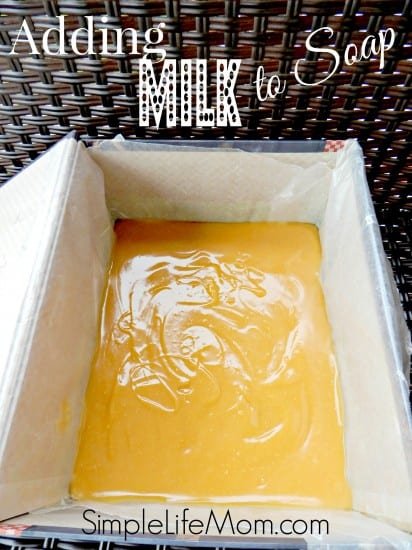
How to Add Milk to Soap - learn how, when, and what to look for when making great soaps like Milk and honey Soap

Why Add Milk to Soap?

  1. Milk increases the moisturizing qualities of your soap.
  2. I believe that milk helps the soap to actually cleanse your skin better.
  3. I use raw milk which also adds extra vitamins and nutrients.  And YES you do absorb them.  How I add the milk does not kill the vitamins and your skin is a large absorbing organ that absorbs the nutrients and moisture.

Can I Use Different Kinds of Milk?

YES!  Some examples are:

  1. Goat’s Milk
  2. Goat’s Cream
  3. Cow’s Milk
  4. Cow’s Cream
  5. Buttermilk
  6. Coconut Milk
  7. Powdered Goat’s or Cow’s Milk – different method
  8. Expired Breast Milk (yes, it’s been done)

Everyone has their favorites.  I do not have goats, but I have access to great raw cow’s milk and it is more than sufficient.  Try some different kinds and take notes as to the difference in the making and the end product so you’ll learn what you like best.
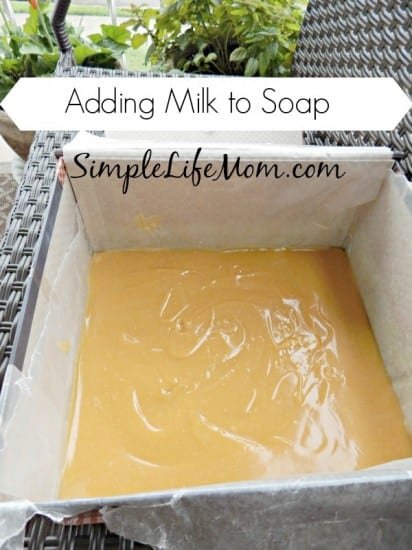
How to Add Milk to Soap - learn how, when, and what to look for when making great soaps like Milk and honey Soap

How to Add Milk to Soap Recipes

How to? Very carefully.  Actually, it’s not that big a deal once you know what to watch for.  What can make adding milk difficult is that the lye spikes in temperature when added to a liquid and it can scorch the milk sugars, causing a very orange color and bad smell.  The smell will not stay in the soap, so that’s not anything to worry about.  But it’s hard to add natural coloring when the soap is going to end up being very dark.  Plus, you can kill all the good nutrients in the milk when you allow it to be scorched.  The soap in the pictures looks more yellow in the picture than it really is, and soap always gets lighter as it cools.  These Raw Milk and Honey Shampoo Bars were fresh out of the pot.

First, decide how much water you want to replace with milk in your favorite recipe.

Here are a few methods:

  1. Add the lye to the milk or milk/water combination VERY slowly!  I’m meaning, add a tiny bit and stir, wait 5-10 minutes and add more.  Add a teeny bit more and wait.  Continue until you have added all the lye.
  2. Measure and Combine your milk and water.  Put it in the freezer until it is half frozen (not solid).  I’ve read that some people put it in ice cube trays and add a cube at a time to their water.  Slowly add the lye, watching the temp to make sure it doesn’t go too high.  Remember, if you make it too cool you can always put the lye mixture in a hot water bath to increase the temp. slightly if you need to.
  3. If you are using a powdered milk product, make sure it is of good quality with  no nasty extra ingredients.  Either reconstitute with the water needed and follow method one (above), or add at trace. If you add at trace, make sure you add a little bit of water and stir before putting it in the pot, otherwise you will have lumps.
  4. If you are using expired breast milk, use method one or two above.  I have not tried this, but I’ve read about a number of people using it and it working great.

Problem Shooting:

If your milk looks like it is starting to curdle, you are adding the lye too quickly.  It’s still ok to use as far as my experience goes, but you need to watch for clumps.

If it starts to look bright yellow, green, or brown it means it’s heating up too fast.  Don’t add any more for a while.

Any questions? Let me know and we can put our heads together and hopefully figure it out.Save


Please Share
36 comments

About Kelly

Kelly is the author of number one best seller The Natural Soap Making Book for Beginners and Easy Soap Making. She's also written multiple ebooks on herbal remedies and natural bath and body DIYs. Her journey toward better health has inspired her to make things in and around the home from scratch, start a homestead, and become more resourceful when it comes to health and home. She shares her recipes and DIYs here on Simple Life Mom and has a shop where she sells products for those who would rather buy than make (SimpleLifeMom.com/shop).

You also might be interested in

Homestead Blog Hop - Homestead tips, ideas, animal care, and recipes every Wednesday

Homestead Blog Hop 500 – Make No Churn Ice Cream

Jun 4, 2024

Please Share Welcome to the Homestead Blog Hop! I can’t[...]

Homemade Pizza Rolls from Scratch from Simple Life Mom

Homemade Pizza Rolls from Scratch

Jan 14, 2014

Please Share When you have some children, it’s important to[...]

Homestead Blog Hop - Homestead tips, ideas, animal care, and recipes every Wednesday

Homestead Blog Hop 570 – Slow Cooker Dessert and Crafts

Oct 14, 2025

Please Share Are you ready for this week? We have[...]

36 comments

Leave your reply.
  • Jennifer A.
    · Reply

    September 1, 2014 at 3:11 PM

    I can’t wait to start making my own goat milk soap! It’ll be a while before my goats start making milk though. I’ll need to come back to this in about a year! Thanks!

    • Kelly
      · Reply

      Author
      September 1, 2014 at 3:58 PM

      Congrats on getting goats 🙂

  • Amanda @MultiTestingMom
    · Reply

    September 4, 2014 at 4:12 PM

    GREAT tips! I’ve shared this post in a Soaper Group that I am a member of 🙂
    Thanks for linking up at Let’s Get Real!

    • Kelly
      · Reply

      Author
      September 4, 2014 at 5:31 PM

      Thank you Amanda!

  • Pure Grace Farms
    · Reply

    September 8, 2014 at 12:14 PM

    Making soap is on my list of to do’s. Love your great tips and am tucking this great info away for later. Thanks for sharing.
    Blessings,
    Shari

  • Dawn @OhSweetMercy
    · Reply

    September 12, 2014 at 7:58 AM

    Thanks for this great post on adding milk to soap! I have made soap a few times and love it, but have not tried adding milk yet. Love your list of milks, too…hadn’t thought of coconut milk, that’s a great idea. And expired breast milk, that NEVER crossed my mind! I chose this as my favorite from last week’s From the Farm blog hop, and it’s featured on our Hop this week, thanks for linking up!

  • Coretta B
    · Reply

    January 22, 2015 at 2:38 PM

    My goat is pregnant! Goat milk soap is in my near future 🙂 Thank you for the tips!

    • Kelly
      · Reply

      Author
      January 22, 2015 at 4:26 PM

      Woo hoo!! Congratulations 🙂

  • LC
    · Reply

    March 24, 2015 at 7:18 PM

    Hi Kelly,

    Do you need to use fresh milk or can you use older, more sour raw milk?

    thanks,
    LC

    • Kelly
      · Reply

      Author
      March 24, 2015 at 10:01 PM

      If it’s raw, sour does not matter. Sour milk that has been homogenized and pasteurized tends to be more rancid than sour.

  • Tanya
    · Reply

    May 29, 2015 at 4:07 AM

    can you add to part water then leave to cool , and add the milk to the cold lye mix?

    • Kelly
      · Reply

      Author
      May 29, 2015 at 7:46 AM

      Yes, but you still want your lye to end up at around 100 degrees Fahrenheit.

  • Rosalie
    · Reply

    October 6, 2016 at 2:32 PM

    I know this post is older, but can you cook soap with milk using a hot process?

    • Kelly
      · Reply

      Author
      October 6, 2016 at 4:27 PM

      Yes. Just use it as you would normally hot process.

  • Kaleo
    · Reply

    February 15, 2017 at 12:59 AM

    I found using macadamia milk in soap is great. Honestly I never knew there was such a thing, but one day as I was shopping for coconut milk (for soap) there it was.

    • Kelly
      · Reply

      Author
      February 15, 2017 at 9:54 AM

      Thanks for the idea Kaleo!

  • kate
    · Reply

    June 1, 2017 at 5:55 AM

    I have read some ppl place their honey soaps in the fridge or freezer to keep th from going through gel phase. Is this something you do? Or do you just leave it on the counter?

    • Kelly
      · Reply

      Author
      June 1, 2017 at 6:41 AM

      Any type of sugars from milk, honey, juice, fruit purees or alcohols can cause the soap to overheat. If you are only adding a Tablespoon of honey to a batch then I wouldn’t worry about it overheating. If you want to add honey and milk, then you should be careful not to over insulate. Some people aren’t worried about over heating. They just want a lighter soap. Going through gel phase causes soap to become darker so that may be why they choose to put it in the fridge. I don’t like interfering too much with the ideal temps. of saponification, so I never place soap in the fridge unless it’s starting to overheat.

  • Alesia
    · Reply

    October 29, 2017 at 10:39 PM

    I’m new to making soap, I have a few goats here that I’m milking for soap and consuming. I’ve read that using frozen raw milk to make soap helps tremendously to prevent overheating. However, keep a sink full of ice to place your soap into in case it heats back up. I love your website! Thanks for your generosity here! God bless. Alesia

    • Kelly
      · Reply

      Author
      October 30, 2017 at 8:52 AM

      I’ve done that too. Getting it frozen or slushy is a big help!

  • Nathalie
    · Reply

    January 12, 2018 at 4:30 PM

    Hi Kelly, I have a lot of walnut oil from my own walnut tree. I would love to use this in my own made soap. Could I use this instead of another oil? And if so how much woul you recommend I use in a batch? I have never made soap before but I’m ready to learn! Thank you for sharing your experience!

    • Kelly
      · Reply

      Author
      January 12, 2018 at 4:48 PM

      You can definitely use walnut oil in soap. You can’t use too much or it will make the soap too soft and bring the cleansing ability down, but you can use it in a small percentage. See the last recipe in my 7 shampoo recipes for a recipe example using walnut oil: https://simplelifemom.com/2013/11/19/7-homemade-shampoo-bar-recipes/

  • natural cosmetics
    · Reply

    February 20, 2018 at 9:39 AM

    Graet and informative article. I will give it a try with raw donkey milk.

  • Tracyanne Robinson
    · Reply

    June 12, 2018 at 12:51 PM

    Please How can I add Cows Milk to a Melt and pour base. I’m allergic to goats milk and have loads of cows milk. I’m loving making soaps but would like something different. Thank you

    • Kelly
      · Reply

      Author
      June 12, 2018 at 1:14 PM

      It’s difficult to add any liquids to a melt and pour recipe because the saponification process has already finished. Thus, the liquids will just sit there. If you want to make a milk soap you need to use the cold or hot processing method instead.

  • Yamuna Pathmanaban
    · Reply

    February 18, 2019 at 1:30 PM

    Hi

    I have tried the goat milk soap but oil gets separated when i was stirring. When i put the milk lye mixture into the oils and stirred for 5 to 10 mins only its get traced. but i still mixing like coconut oil base soap , oil gets separated. I dont know where i did the mistake .

    What is the stirring time for after adding lye milk mixture into oils ? Pl advise.

    • Kelly
      · Reply

      Author
      February 18, 2019 at 2:11 PM

      Make sure your temperatures are warm enough (around 100 degrees Fahrenheit) and use a had mixer or stick blender to blend.

  • Yamuna Pathmanaban
    · Reply

    February 19, 2019 at 4:14 AM

    Thank you so much. how long will it take to get the trace ?

  • Sandra
    · Reply

    July 7, 2020 at 1:20 PM

    Can I use sheep milk in my milk?

    • Kelly
      · Reply

      Author
      July 7, 2020 at 11:06 PM

      Yes you can.

  • Sandra
    · Reply

    October 2, 2020 at 8:49 PM

    If I use buttermilk, can I buy the refrigerated type from the store or is it better to use fresh?

  • Toryah
    · Reply

    October 3, 2020 at 3:53 PM

    Kelly please can i add raw goat milk i got from a goat to my made black soap?

    • Kelly
      · Reply

      Author
      October 5, 2020 at 7:51 PM

      Yes, just substitute water in a recipe with goat milk. You can sub just a little or the whole amount.

  • Kimberly McColley
    · Reply

    April 16, 2026 at 8:17 AM

    Can you add the goats mix to oil solution or does it have to be mixed in with water then lye?

    I love following you, I’ve been making soap for 3 yrs. Looking for new ways. Thank you!

    • Kelly
      · Reply

      Author
      April 21, 2026 at 8:21 AM

      You can definitely add goat milk to the oils. The reason it’s usually added to instead of water is because you have to have enough water/milk to dissolve the lye. If you are using powdered goat milk, definitely add it to the oils. If you are just replacing a small amount of the water with milk you can add the milk to the oils, but make sure there’s still enough water to dissolve the lye well.

Leave a Reply

We'd love to hear your thoughts and ideas!
Cancel Reply

Recipe Rating


Join the Simple Life Mom Community

And get a FREE Bath and Body Recipe E-Book:

Thank you!

Check your email and add me to your address list so messages don't go to spam. 

You'll have a link to the free e-book in the email.

Kelly

SHOP

Join Us and Get New DIYs and Recipes Subscribe

Categories

  • Soap Making
  • Bath and Beauty
  • Health and Essential Oils
  • Home and Garden
  • Homestead Blog Hop
  • Real Food Recipes

Books

  • Natural Soap Making Book for Beginners
  • Easy Soap Making
  • Natural Soap Making How-To and Recipe Book
  • Make it Yourself: Bath & Home DIY for Self Sustainability
  • Natural Beauty from Head to Toe
  • Herbs & Essential Oils in Soap Making

SHOP

Other Resources

  • Mountain Rose Herbs
  • Herbal Academy
  • Amazon
  • Revelation Health

© 2026 Simple Life Mom - All Rights Reserved

  • Disclaimers/Policies for Simple Life Mom

Press Enter to search · Esc to close